Is Now Peer-Reviewed and Published
by Nicolas Hulscher, MPH
Finally, we declare a major victory against the Academic Journal Cartel and their PubPeer Mob enforcement apparatus.
Earlier this year, our landmark study—“Synthetic mRNA Vaccines and Transcriptomic Dysregulation: Evidence from New-Onset Adverse Events and Cancers Post-Vaccination”— became one of the most-read and most-downloaded preprints in the world.
Shortly thereafter, it was abruptly withdrawn by MDPI for a vague and unexplained reason:
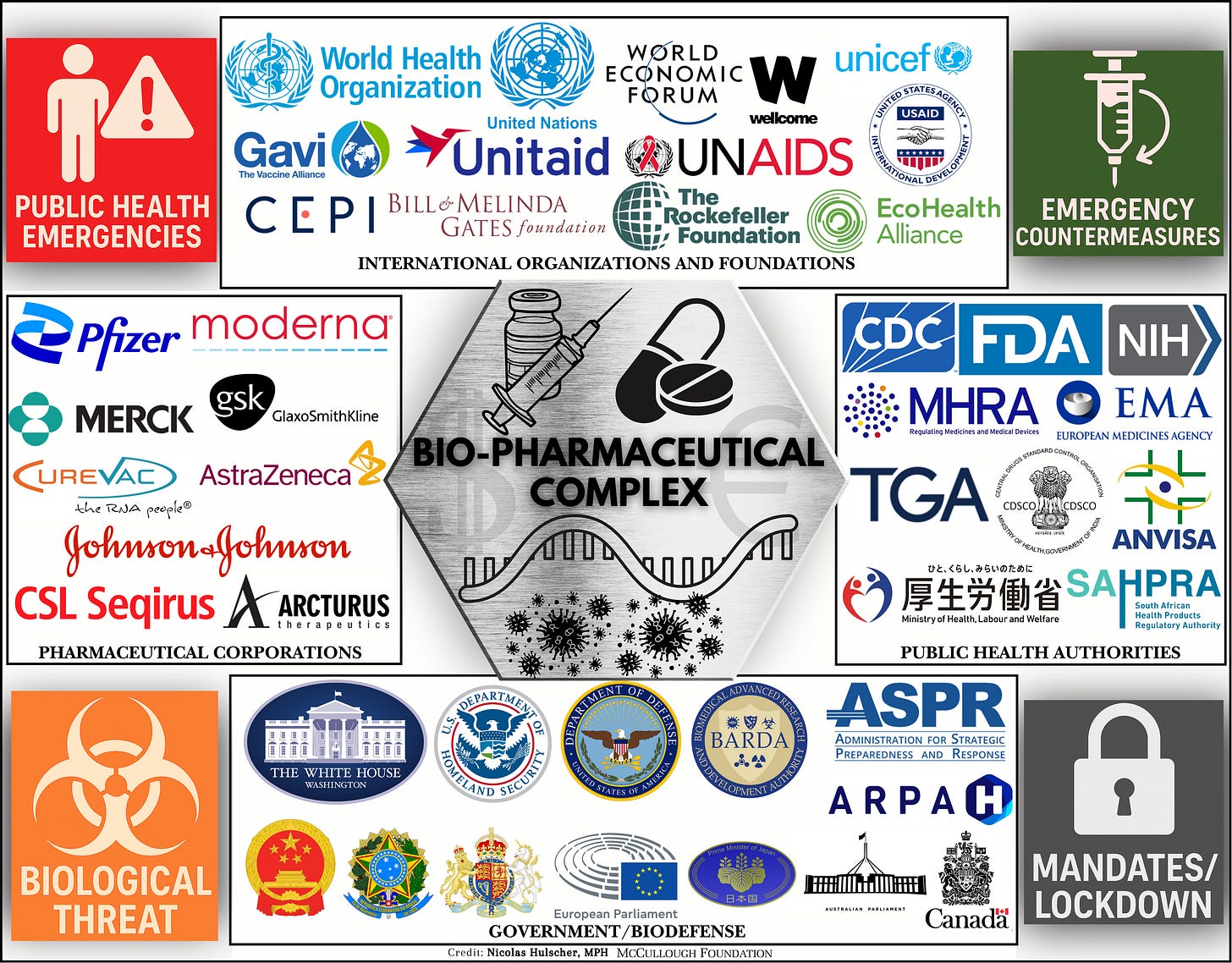
We identified that this unethical removal was likely the result of coordinated Bio-Pharmaceutical Complex pressure and PubPeer mob attacks, intended to shield the deadly mRNA platform.
Their efforts have failed miserably.
Now, our landmark study — Synthetic messenger RNA vaccines and transcriptomic dysregulation: Evidence from new-onset adverse events and cancers post-vaccination — documenting severe, long-lasting transcriptomic disruption following COVID-19 mRNA injections has been officially peer-reviewed and published in the World Journal of Experimental Medicine, a PubMed.gov indexed journal.
The study was conducted by scientists from Neo7Bioscience (Dr. John Catanzaro, Dr. Natalia von Ranke, Dr. Wei Zhang, Dr. Philipp Anokin), the McCullough Foundation (Dr. Peter McCullough and Nicolas Hulscher) and Medicinal Genomics (Kevin McKernan).
Using high-resolution RNA sequencing of blood samples and differential gene expression analysis, we found that COVID-19 “vaccines” severely disrupted the expression of thousands of genes—inducing mitochondrial failure, immune system reprogramming, and oncogenic activation that persisted for months to years after injection.
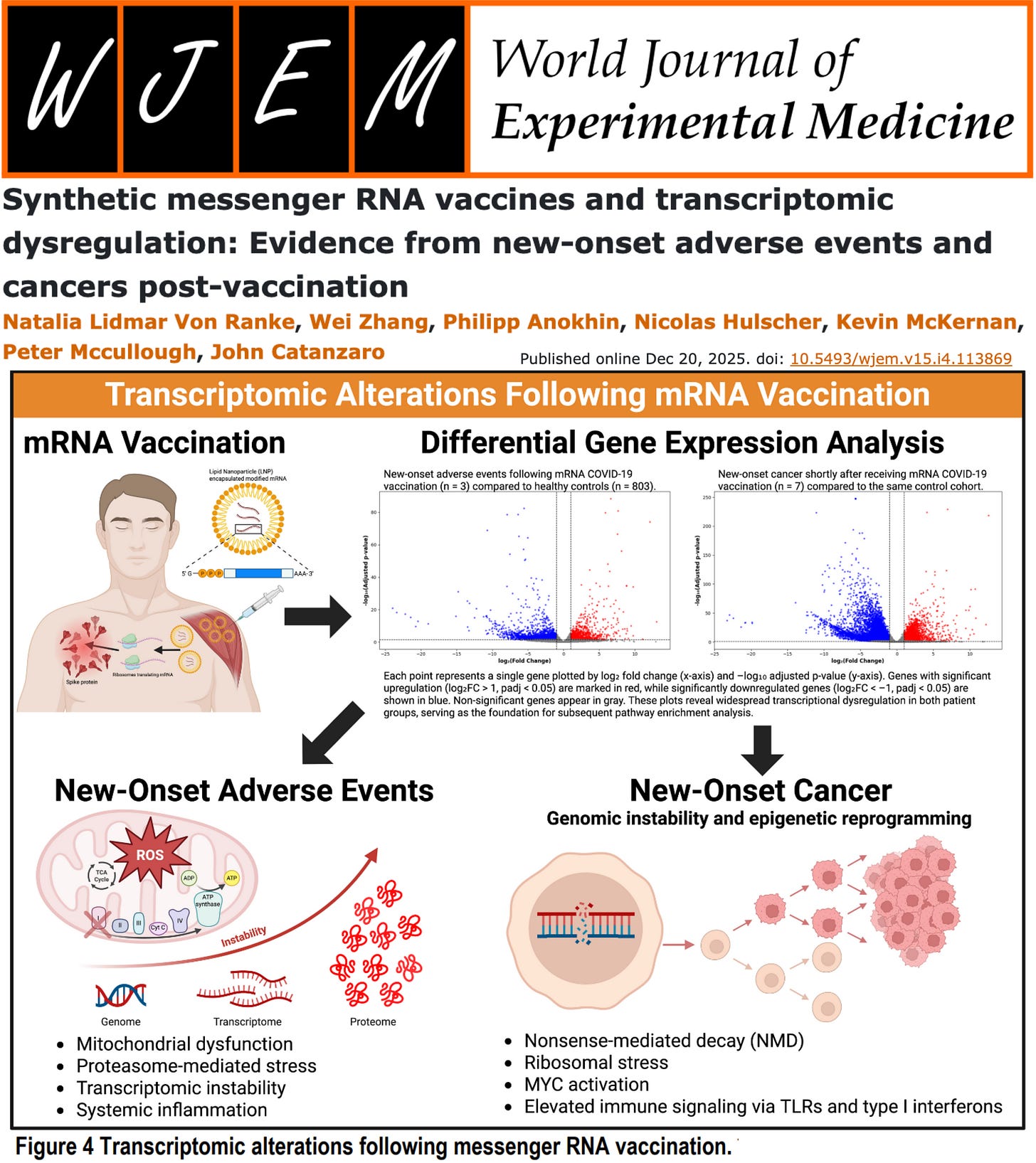
The study analyzed whole blood RNA profiles from:
3 patients with new-onset adverse events (neurological, cardiovascular, chronic fatigue) following mRNA vaccination
7 patients newly diagnosed with cancer post-mRNA vaccination
803 healthy controls
Key tools and analyses:
Bulk RNA sequencing (Illumina NextSeq) of patient blood samples
DESeq2 for differential gene expression analysis
Gene Set Enrichment Analysis (GSEA) to identify disrupted biological pathways
STRING + Cytoscape to visualize protein-protein interaction (PPI) networks of dysregulated genes
Both vaccine injured groups showed massive gene dysregulation compared to healthy controls—hundreds of genes up- or down-regulated, especially in pathways tied to:
Mitochondrial dysfunction
Protein folding and degradation stress (proteasome pathways)
Ribosomal overload and nonsense-mediated decay (NMD)
Chronic systemic inflammation
Oncogenic activation (MYC) and tumor suppressor suppression (p53, KRAS)
Shared Hallmarks in Both GroupsMitochondrial Dysfunction & Oxidative Stress
Complex I disruptions and ROS overproduction—core features of chronic fatigue and neurodegeneration.
Ribosomal Stress & Translational Overdrive
Synthetic mRNA with modified bases (N1-methylpseudouridine) appears to trigger ribosomal overload, translation errors, and RNA surveillance activation. These stress signatures are also consistent with host responses to foreign genetic material, and may reflect reverse transcription of mRNA via endogenous LINE-1 activity, residual plasmid DNA, or vector-derived promoter activity—raising the possibility of persistent transcription or genomic integration.
Proteasome Activation
Likely due to spike protein persistence and accumulation of misfolded proteins.
Endothelial Dysfunction & Coagulopathy
Genes regulating angiogenesis and coagulation were downregulated—mirroring thrombotic complications post-vaccination.
Oncogenic Signals
Activation of MYC, suppression of p53 and KRAS inhibitors, setting the stage for tumor growth.
Genomic Instability & Epigenetic Reprogramming
Strong upregulation of genes linked to chromatin remodeling, DNA methylation, and nucleosome displacement—hallmarks of early tumorigenesis.
Hyperactivation of Type I Interferon and Toll-like Receptor (TLR) Pathways
Persistent immune system stimulation via TLRs, IRFs, and JAK-STAT—common in both chronic inflammation and cancer immune escape.
ACE2 Downregulation
Both groups showed severe suppression of ACE2, activating the Ang II → AT1R → NF-κB/MAPK cascade—a known tumor-promoting and inflammatory loop.
To our knowledge, this is the first study to show long-term genetic disruption in individuals harmed by the COVID-19 mRNA injections.
These findings strongly suggest:
mRNA vaccines can induce gene expression profiles consistent with tumor formation and chronic disease
mRNA-vaccinated individuals may be at heightened risk of cancer, immune dysfunction, and inflammatory disorders
The synthetic mRNA and long-lasting spike protein appear to create sustained cellular stress that disrupts normal genetic regulation
Signatures suggest potential genomic integration of vaccine mRNA and/or plasmid DNA
This study’s journey—from record-setting public interest, to coordinated censorship, to eventual peer-reviewed publication—exposes a profound crisis in modern scientific governance.
The attempt to bury this work through preprint withdrawal, platform erasure, and mob-style enforcement did not refute the data. It only confirmed the threat the findings pose to the Bio-Pharmaceutical Complex:
Despite these efforts, the science endured. The data survived independent scrutiny. The manuscript passed external peer review. And the conclusions remain intact.
Now, two things need to happen:
Immediate market withdrawal of the mRNA injections
Formal RICO investigations into the Academic Journal Cartel and its PubPeer enforcement apparatus
Von Ranke NL, Zhang W, Anokhin P, Hulscher N, McKernan K, McCullough P, Catanzaro J. Synthetic messenger RNA vaccines and transcriptomic dysregulation: Evidence from new-onset adverse events and cancers post-vaccination. World J Exp Med. 2025;15(4):113869. doi:10.5493/wjem.v15.i4.113869
Nicolas Hulscher, MPH
Epidemiologist and Foundation Administrator, McCullough Foundation
www.mcculloughfnd.org
Please consider following both the McCullough Foundation and my personal account on X (formerly Twitter) for further content.
#1: Horse To: Horse (#0)
clean water..... or genocide??
by Matthew Hoh
The Congress can’t agree on ensuring Americans have healthcare, other than it should be ruinously expensive if you ever get sick, but they sure can agree on spending a gargantuan sum for war.
From today’s interview with Redacted with Natali and Clayton Morris:
When we say the Pentagon budget is $901 billion, that’s leaving out an awful lot. For one thing, there was a supplemental passed by the Congress last spring that added $150 billion to the defense bill, including over $100 billion for FY2026. which means that the actual Pentagon budget for 2026 will be over one trillion dollars but that leaves out a heck of a lot as well.
It leaves out tens of billions of dollars that goes to the State department for military assistance to foreign countries as well as to facilitate weapon sales to foreign countries, but the big money comes in two areas where it misses out.
One is for veterans. This year, or in 2026, the veterans budget will be $440 billion. So that’s what you’re paying for men and women like myself, for our health care, our disability pensions, our benefits, etc. All the consequences of political decisions to go to war.
So this idea that these wars don’t ever end, there’s an economic component to it as well. The other aspect about how these decisions [to go to war] don’t end, is in the interest and debt payments on past wars and military spending. So from 2001 to 2021, at the time of the retreat from Afghanistan by the US government, by the American government, the United States had already spent a trillion dollars in interest and debt payments on the wars in Afghanistan and Iraq. So for those 20 years, we spent a trillion dollars in debt payments to finance those wars. That number is going to reach two trillion dollars by 2030. That’s just for the wars in Iraq and Afghanistan.
https://www.antiwar.com/blog/2025/12/18/matthew-hoh-on-the-1-7-trillion-war-budget/
Horse posted on 2025-12-22 09:08:25 Reply Private Reply